← All guides
How Vehicle History Reports Work
Learn how vehicle history reports work, where the data comes from, and why combining many national record sources catches more than any single check.
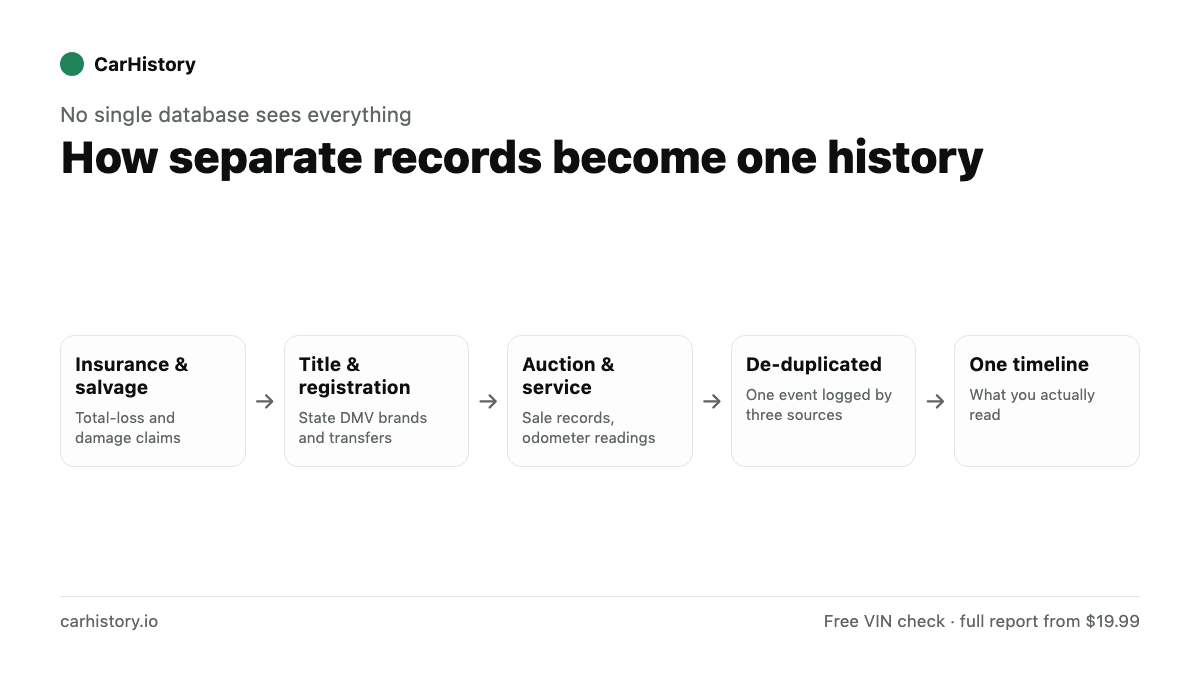
A vehicle history report is a record of a used car’s past, built by gathering events tied to its VIN from across the country. The data comes from insurance and claims records, salvage and auction files, state title and registration databases, service and inspection shops, and manufacturer recall notices, then combined into one timeline.
Where the data comes from
No single database holds a car’s full story. A useful report stitches together separate streams of public and industry records, each covering a different kind of event.
Insurance total-loss and claims data
When a car is in a serious crash or flood, an insurer often files a claim and may declare it a total loss. These records can flag damage, the rough severity, and whether the vehicle was written off, even when the seller never mentions it.
Salvage and auction records
Cars that are wrecked, written off, or sold wholesale frequently pass through salvage yards and auto auctions. Auction lots and salvage filings reveal prior damage announcements, wholesale resales, and vehicles that bounced between dealers before reaching a retail lot.
State title and DMV or registration records
Motor-vehicle agencies in each state record title transfers, registrations, and title brands such as salvage, flood, lemon, or junk. These records also capture odometer readings logged at each title change, which is the backbone of rollback detection.
Service and inspection records
Repair shops, dealers, and inspection stations report visits, mileage, and work performed. A consistent service trail suggests a car was maintained, and the mileage logged at each visit helps confirm the odometer is honest.
Manufacturer recall notices
Automakers issue safety recalls tied to specific build ranges. A report can match a VIN against open recalls so you know whether a known defect was ever addressed.
How records are matched and combined
Every record above is anchored to the Vehicle Identification Number, the unique 17-character code stamped on each car. That shared key is what makes a single, coherent report possible.
The process works in three steps:
- Match by VIN. Each incoming record is keyed to its VIN, so an insurance claim, an auction lot, and a DMV title transfer for the same car all line up under one identity.
- De-duplicate. The same event often surfaces in more than one source. When a single accident or title change appears in multiple feeds, it is collapsed into one entry instead of being counted several times.
- Combine into one timeline. The cleaned, merged events are ordered into a single chronological history, so you read the car’s life start to finish in one place.
Because the sources differ in how they word and date events, this matching and de-duplication step is what turns a pile of raw records into something readable. To see the structure of a finished report before you buy, look at a sample report.
What’s inside a report
A complete report pulls the matched records into a few clear categories:
- Accidents and damage drawn from insurance, salvage, and auction records.
- Title brands such as salvage, flood, lemon, and junk from state title databases.
- Odometer readings and rollback checks built from mileage logged at title changes and service visits.
- Ownership history showing how many owners a car has had and in which states.
- Open recalls matched against the manufacturer’s active safety notices.
- Service records where reporting shops and inspection stations have data on file.
- A History Score that distills the findings into a single at-a-glance rating, so you can quickly gauge whether a car’s past is better or worse than typical.
For a closer look at one of the most important categories, read what is a salvage title.
Why more sources catch more
Reporting is voluntary for many shops and varies by state, so any single feed has gaps. An insurer might log a crash that never reaches a title database. An auction might announce prior damage that a service network never sees. A title brand might be recorded in one state on a slower schedule than another.
A report built from many national sources closes those gaps. When records from insurance, salvage, auction, title, service, and recall feeds are combined and de-duplicated, an event missing from one stream still shows up through another. That is the core advantage over checking a single source: a clean result from one feed is reassuring, but it is not proof the car is clean everywhere.
You do not have to pay just to get started. A free VIN check shows the year, make, and model and how many records exist before you spend anything, and our pricing is straightforward with no surprises. For more on what you can learn for nothing, see the free VIN check guide.
Before you buy a used car, run a free VIN check and see what is already on file.
Sources
- NMVTIS (U.S. Department of Justice) — The federal title system that underpins brand and odometer data in the United States.
- NICB VINCheck — NICB’s own explanation of what a free insurance-records check covers, and what it does not.
Check your vehicle's history