← All guides
Free VIN Check: What You Can See for Free
A free VIN check confirms the year, make, and model and shows whether vehicle-history records exist. See what is free versus what a paid report adds.
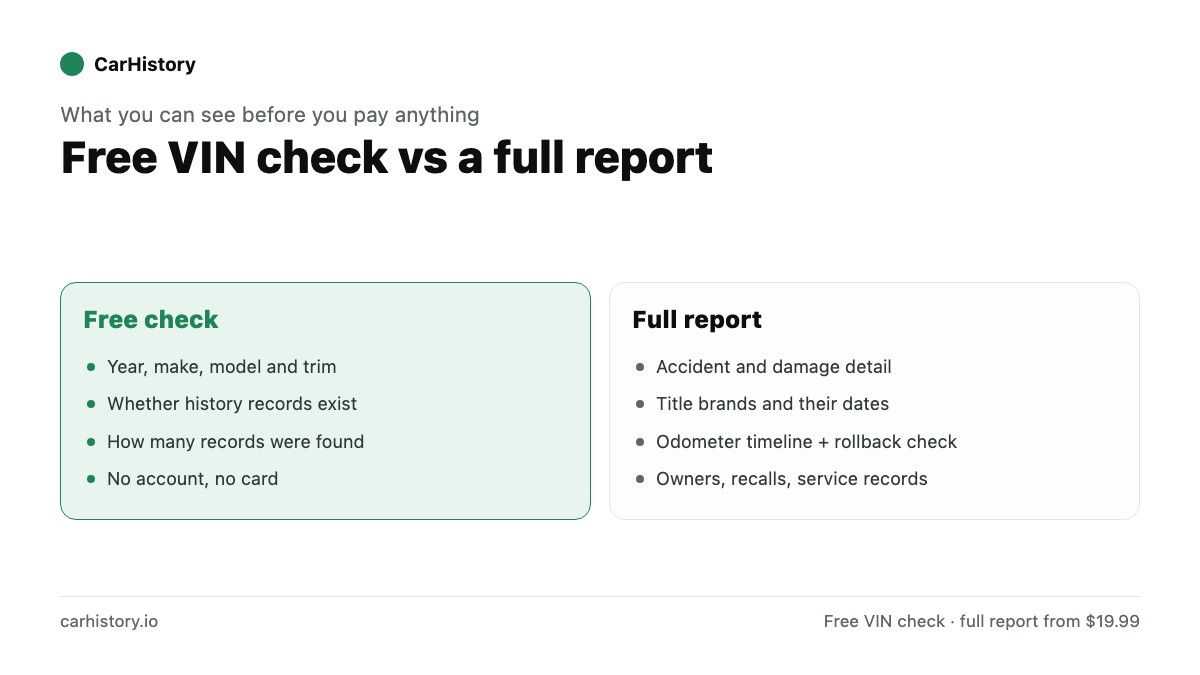
A free VIN check confirms a vehicle’s basic identity (year, make, and model) and tells you whether any vehicle-history records exist for that VIN. It does not unlock the details inside those records. To see accidents, title brands, odometer history, and ownership, you buy a full report compiled from insurance, salvage, title, auction, service, and motor-vehicle records.
What a free VIN check shows you
When you enter a 17-character VIN into a free VIN check, the goal is to decode the vehicle and preview how much history is on file before you spend anything. You typically see:
- The decoded year, make, and model (and often trim or body style) read straight from the VIN.
- Whether the VIN is valid and properly formatted.
- A record count: how many history records exist for the vehicle across our national sources.
That record count is the most useful free signal. A VIN with many records usually means a longer, more detailed paper trail. A VIN with few or no records means there is little to unlock, which is worth knowing before you pay.
Why the year, make, and model matter
Decoding the VIN is a quick fraud check. If the year, make, and model that come back do not match the listing or the car in front of you, stop. Mismatches can point to a cloned VIN, a typo in the ad, or a swapped plate. Confirming the basics costs nothing and can save you from a bad deal. To understand where these details live inside the VIN, see How to Read a VIN: Decode All 17 Characters.
What a free check does not show
A free check tells you that records exist, not what they say. The content inside those records stays locked until you open a full report. That means a free check will not reveal:
- Reported accidents and damage.
- Title brands such as salvage, flood, lemon, or junk.
- Odometer readings and rollback checks.
- Ownership history and how many previous owners.
- Open recalls and service records.
- The History Score.
In other words, a free check is the trailer; the paid report is the full movie. If the free check shows zero records for a VIN, there may be nothing to buy yet. Learn what an empty result means in VIN Not Found? What It Means and What to Do.
What a paid report adds
A paid report uses one credit and unlocks the full history behind those record counts. Here is what comes into view:
- Accidents and damage — reported collisions, structural damage, and airbag deployments where available.
- Title brands — salvage, flood, lemon, junk, and rebuilt designations that affect safety and value. See Title Brands Explained.
- Odometer and rollback checks — mileage readings over time, flagged when numbers move backward or jump suspiciously.
- Ownership history — how many owners, registration changes, and how the vehicle was used.
- Open recalls — outstanding safety recalls you should have fixed before driving.
- Service records — maintenance entries that show how the car was cared for.
- History Score — a single number that summarizes overall risk.
The combined-report advantage
CarHistory’s difference is that it does not make you choose one data source. It combines records from multiple national databases into one de-duplicated report, so a flood title reported by one source and an accident reported by another both show up in the same place. If you want to understand how these reports are built, read How Vehicle History Reports Work. To see the layout before you buy, browse a sample report.
How to run a free VIN check
The process takes under a minute:
- Find the VIN. It is on the lower-left corner of the windshield, on the driver-side doorjamb sticker, and on the title and registration.
- Confirm 17 characters. A real VIN has exactly 17 characters and never uses the letters I, O, or Q.
- Enter it in the free VIN check box.
- Read the preview. Confirm the year, make, and model, then check how many history records exist.
- Decide. If records exist and the car interests you, unlock the full report.
When the free check is enough — and when it is not
A free check is enough when you are just confirming a VIN is real, matches the listing, and has history on file. It is a fast filter for a list of candidate cars.
It is not enough the moment you are serious about a specific vehicle. Many problems that change a car’s value or safety — a rolled-back odometer, a quietly rebuilt salvage title, hidden flood damage — only appear inside the records, never in the free preview. Before you hand over money, it pays to open the full history. For a deeper walk-through, see How to Spot an Odometer Rollback and the Used Car Buying Checklist.
A note on cost and refunds
If you buy a report and no data is found for that VIN, the credit is refunded automatically — you are never charged for an empty report. That makes it low-risk to dig deeper on a car you like. Compare options on the pricing page, and if you are weighing the value, see Is a Vehicle History Report Worth It?.
Ready to start? Run a free VIN check now and see exactly how much history is waiting behind the car you are considering.
Sources
- NICB VINCheck — Free, limited to five searches per IP address per 24 hours, covering theft, salvage and flood records from participating member insurers.
- NHTSA vPIC VIN Decoder — Free federal decoder returning the year, make, model and build details encoded in a VIN.
- NMVTIS (U.S. Department of Justice) — Federal title, brand and odometer records, available through approved providers.
Check your vehicle's history