← All guides
What Is a Salvage Title? How to Check Before You Buy
A salvage title means a car was declared a total loss by an insurer. Learn the risks, how it happens, and how to check any VIN before you buy.
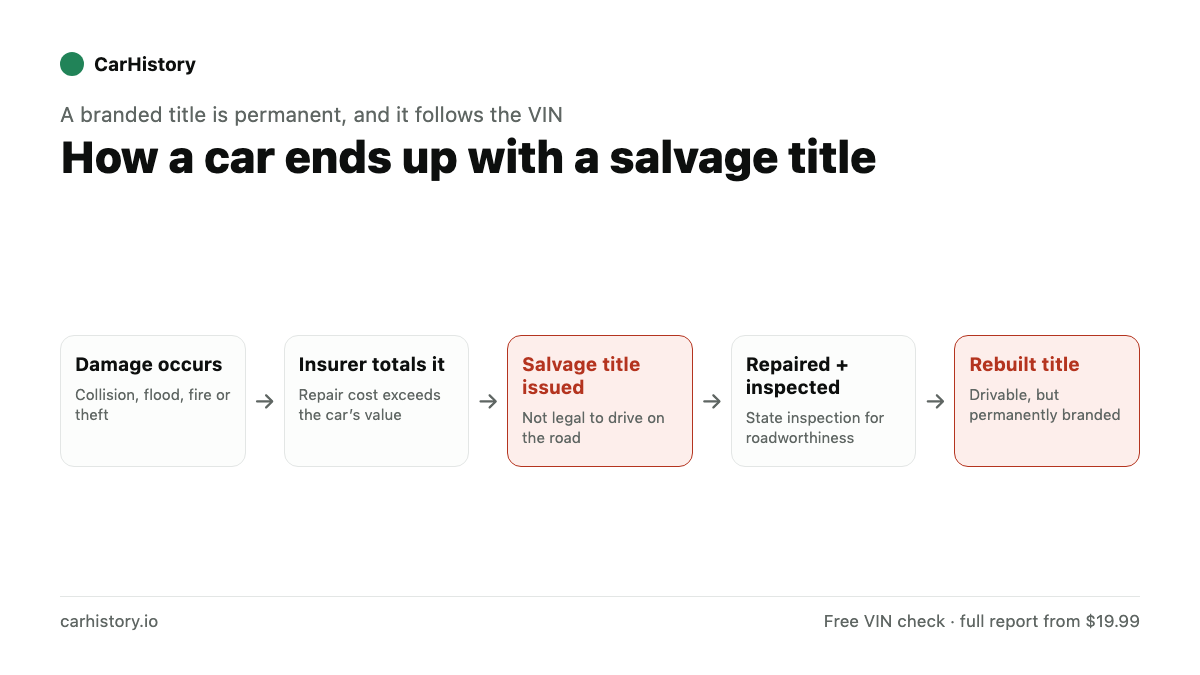
A salvage title is a legal designation a state issues when a vehicle is declared a total loss, usually because an insurance company decided the cost to repair it was too high relative to its value. It tells you the car had serious damage from a crash, flood, fire, theft, or similar event. A salvage title stays on the vehicle’s record permanently.
How a car gets a salvage title
A salvage title is issued through the insurance and titling process, not by a mechanic’s opinion. The path usually looks like this:
- A car is damaged in a major event such as a collision, flood, fire, hailstorm, or theft recovery.
- The owner files an insurance claim.
- The insurer estimates repair costs. If those costs (sometimes combined with the car’s pre-loss value) cross a state-defined threshold, the insurer declares the vehicle a total loss.
- The state issues a salvage title, branding the vehicle so future buyers are warned.
Each state sets its own total-loss threshold, so an identical car might be totaled in one state and repaired in another. That is one reason the same VIN can carry different history depending on where it was titled.
Salvage title vs. rebuilt title
People often confuse these two, but they mean different things:
- Salvage title: The car is not considered roadworthy and generally cannot be registered or driven legally until it is repaired and inspected.
- Rebuilt (or reconstructed) title: A salvaged car that has been repaired and passed a state inspection, allowing it back on the road. It is no longer “salvage,” but the brand history remains.
Neither brand disappears. Both follow the VIN for the life of the vehicle and show up on a history report. For a fuller breakdown of every brand you might see, read Title Brands Explained.
The risks of buying a salvage or rebuilt car
A salvage or rebuilt vehicle can be a reasonable purchase if you know exactly what you are getting, but the risks are real:
- Hidden structural damage. Cosmetic repairs can mask bent frames, compromised crumple zones, or unrepaired safety components.
- Lower resale value. A branded title typically reduces what the car is worth, and it can be harder to sell later.
- Insurance and financing hurdles. Some lenders will not finance a branded vehicle, and some insurers limit coverage.
- Safety unknowns. Airbags, sensors, and electronics may not have been properly restored, especially after flood damage.
- Quality of repairs varies widely. Two rebuilt cars with the same brand can be worlds apart depending on who did the work.
The brand itself does not tell you the quality of the repair. That is why a history report plus an independent inspection matters so much.
How to check a VIN for a salvage title
You do not have to take a seller’s word for it. The vehicle identification number is your key to the car’s recorded past.
- Find the 17-character VIN. It is on the dashboard near the windshield, the driver’s door jamb, the title, and the registration. If you are unsure how to read it, see How to Read a VIN.
- Run a free check first. A free VIN check confirms the year, make, and model and shows how many history records exist for that VIN, so you know whether history data is available before paying anything.
- Pull the full report. A paid report unlocks title brands, accident and damage records, odometer readings, ownership history, open recalls, and more. CarHistory combines records from multiple national databases into one de-duplicated report, so a salvage or total-loss event recorded by any source surfaces in one place.
- Read the title brand fields carefully. Look for words like salvage, rebuilt, reconstructed, junk, flood, or total loss anywhere in the title history.
You can see exactly how brands and damage records appear in a sample report before you buy. Curious how these reports are built? Our guide on How Vehicle History Reports Work explains why combining multiple sources gives you a more complete picture.
What to do if you find a salvage title
Finding a salvage brand is not automatically a reason to walk away, but it changes your approach:
- Ask for documentation. Request repair invoices, inspection certificates, and photos of the damage before and after.
- Get an independent inspection. Have a trusted mechanic or body shop examine the structure, frame, and safety systems.
- Negotiate accordingly. A branded title should be reflected in the price.
- Check for related issues. Salvage often overlaps with flood or odometer concerns, so review our guides on flood damage and odometer rollback too.
When data is not found
Not every VIN returns records, especially for newer cars or those with limited reporting. If no data appears, that does not guarantee a clean past, it may simply mean nothing has been reported yet. With CarHistory, if a paid report turns up no data, your credit is automatically refunded, so you are never charged for an empty report. Learn more in VIN Not Found? What It Means.
The bottom line
A salvage title is a permanent flag that a vehicle was once a total loss. It is not always a dealbreaker, but it demands extra diligence: documented repairs, an independent inspection, and a fair price. The fastest way to know what you are dealing with is to check the VIN before you fall in love with the car.
Ready to find out? Run a free VIN check and see what records exist for the car you are considering.
Sources
- NMVTIS (U.S. Department of Justice) — The federal system that consolidates state title records, including salvage and other brands.
- NICB VINCheck — A free check against theft, salvage and flood records reported by participating member insurers.
Check your vehicle's history