← All guides
How to Read a VIN: Decode All 17 Characters
Learn how to read a VIN by decoding all 17 characters, from the WMI and vehicle descriptor to the check digit, model year, plant, and serial number.
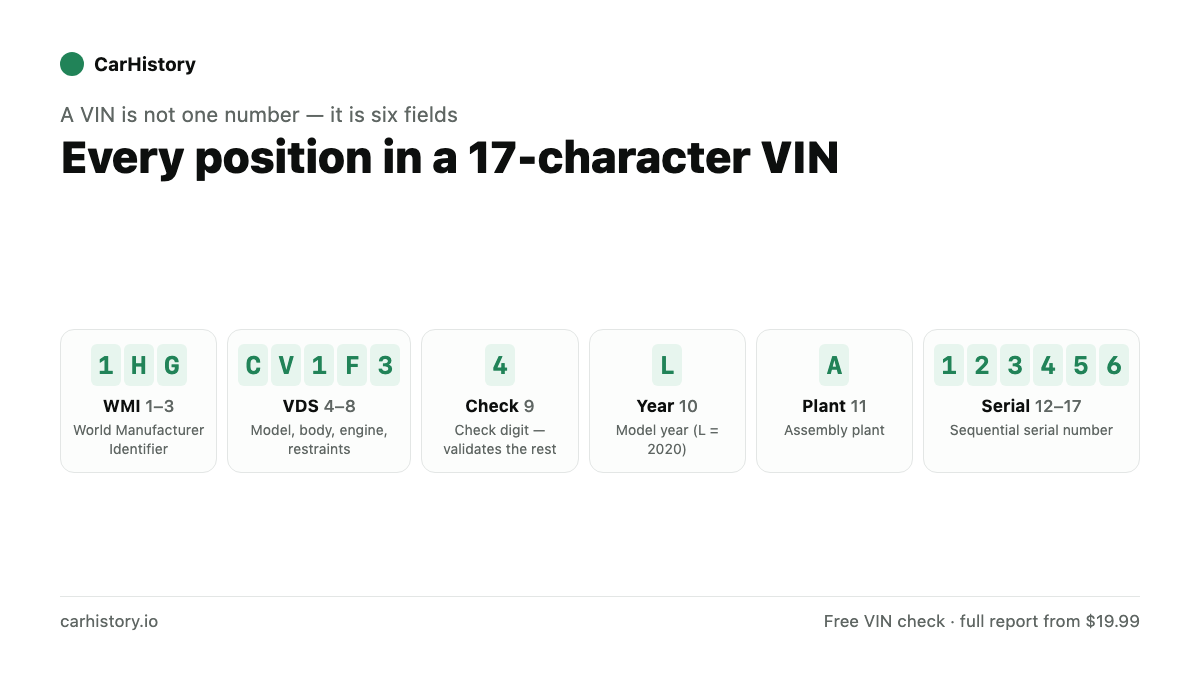
A Vehicle Identification Number (VIN) is a 17-character code that uniquely identifies a single vehicle. To read a VIN, split it into groups: characters 1-3 are the World Manufacturer Identifier, 4-8 describe the vehicle, 9 is a check digit, 10 is the model year, 11 is the plant, and 12-17 are the serial number.
What a VIN Is and Why It Matters
Since 1981, every car and light truck sold in North America uses a standardized 17-character VIN. No two vehicles share the same one. The VIN is the key that links a car to its records: title history, recalls, accidents, and odometer readings. When you run a free VIN check, this is the number you type in.
VINs never include the letters I, O, or Q, because they look too much like the numbers 1 and 0. If you see one of those letters, you have misread the code.
Where to Find the VIN
The VIN appears in several places so you can confirm it matches across documents:
- On the dashboard, visible through the windshield on the driver’s side
- On a sticker inside the driver’s door jamb
- On the title, registration, and insurance card
- On the engine block and other stamped components
Always check that the VIN matches in every location. A mismatch can be a red flag for a stolen or rebuilt vehicle.
Decoding the 17 Characters
Each position in the VIN carries specific meaning. Here is how the structure breaks down.
Characters 1-3: World Manufacturer Identifier (WMI)
The first three characters identify who built the vehicle and where.
- The first character is the country or region of assembly. For example, 1, 4, and 5 indicate the United States; 2 is Canada; 3 is Mexico; J is Japan; W is Germany.
- The second character points to the manufacturer.
- The third character identifies the vehicle type or manufacturing division.
Together, these tell you the make and the country of origin at a glance.
Characters 4-8: Vehicle Descriptor Section (VDS)
Positions four through eight describe the vehicle itself. Manufacturers use these five characters to encode details such as:
- Model and body style
- Engine type and size
- Transmission
- Restraint system (airbags and seatbelts)
The exact meaning of each character varies by manufacturer, so a decoder reads them against that maker’s coding scheme.
Character 9: Check Digit
The ninth character is a check digit. It is calculated from all the other characters using a fixed math formula. Its only job is to confirm the VIN is valid and was not mistyped or altered. If the check digit does not match the calculation, the VIN is wrong or fake. This is one reason a VIN that is not found can simply be a typo.
Character 10: Model Year
The tenth character is the model year. It cycles through letters and numbers on a known schedule. For example, a stands for a certain year, b the next, and so on, skipping the excluded letters. Numbers are used for some years too. Because the cycle repeats roughly every 30 years, you read it together with the rest of the VIN to land on the correct decade.
Character 11: Plant Code
The eleventh character identifies the specific assembly plant where the vehicle was built. Each manufacturer assigns its own plant codes, so this character only makes sense in combination with the WMI.
Characters 12-17: Serial Number
The final six characters are the production sequence number. This is the unique serial that separates your exact vehicle from every other one rolling off the same line. On lower-volume vehicles, some of these positions may include letters as well as numbers.
Quick Reference Table
Position
Section
What it tells you
1-3
WMI
Country, manufacturer, vehicle type
4-8
VDS
Model, body, engine, restraints
9
Check digit
Validity of the VIN
10
Model year
The year the vehicle was built as
11
Plant
Assembly plant
12-17
Serial
Unique production sequence
Reading the VIN Is Only the First Step
Decoding the VIN tells you what a vehicle is. It does not tell you what has happened to it. For that, you need the vehicle’s history: accidents, title brands, and odometer records tied to that same number.
A full report pulls those records together. CarHistory goes a step further by combining records from multiple national databases into one de-duplicated report, so you do not have to compare sources yourself. See how those reports are built in How Vehicle History Reports Work, or look at an example in our sample report.
Once you can read a VIN, put it to work. Learn what you can see for free in our free VIN check guide, and review pricing when you are ready to unlock the full history.
Ready to decode your car’s past? Enter the 17-character VIN above to run a free check.
Sources
- 49 CFR Part 565 — Vehicle Identification Number (VIN) Requirements — The federal regulation that defines the 17-character VIN and what each position must contain.
- NHTSA vPIC VIN Decoder — Free federal decoder that resolves a VIN to its year, make, model and build details.
Check your vehicle's history