← All guides
How to Spot an Odometer Rollback
Learn the warning signs of odometer fraud and how a vehicle history report's odometer timeline exposes a rolled-back mileage reading before you buy.
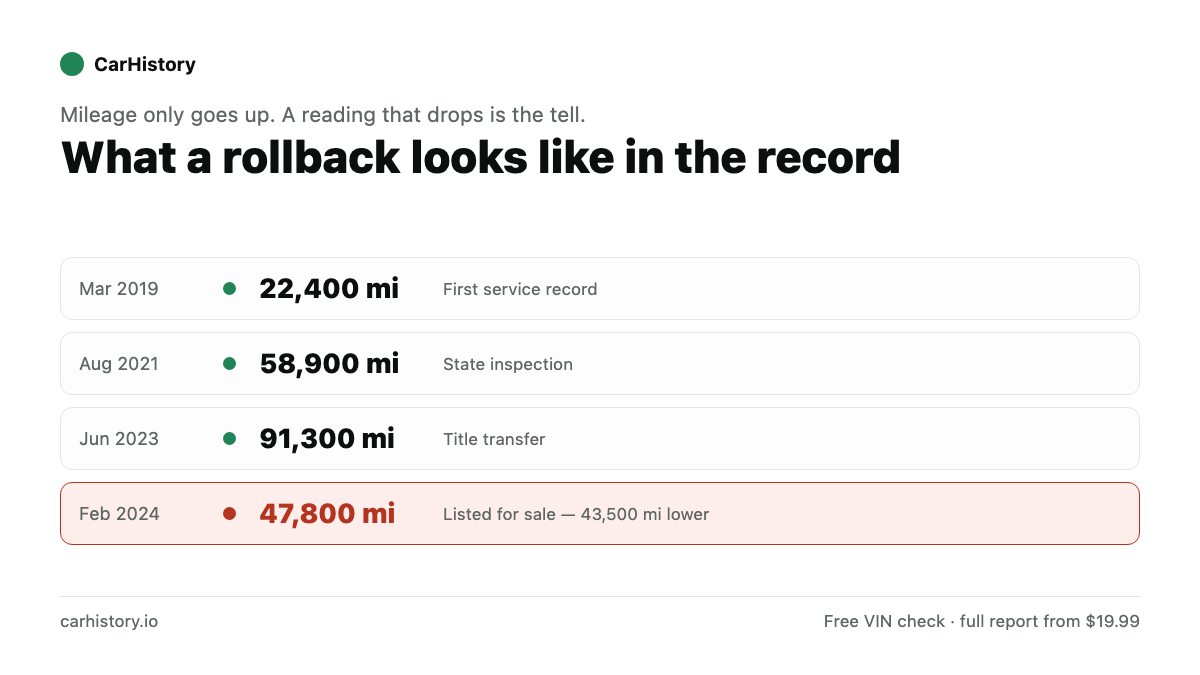
An odometer rollback is when someone illegally winds back a vehicle’s mileage to make it look less used and worth more than it really is. You can spot it by comparing the odometer reading on the dashboard against the documented mileage history in a vehicle history report. A reading that drops over time, or jumps unrealistically, is a red flag for fraud.
What Is an Odometer Rollback?
This is not a rare crime. NHTSA estimates that more than 450,000 vehicles are sold each year in the United States with false odometer readings.
Mileage is one of the biggest factors in a used car’s price. Lower miles usually mean less wear, so fraudsters tamper with the odometer to inflate a vehicle’s value. With digital dashboards, rolling back the number can take minutes and leaves no obvious mark on the car itself.
Rollback fraud hurts buyers in two ways. You overpay for a car that is more worn than it appears, and you face earlier repairs and maintenance because the true mileage is higher than the dashboard shows. That is why an independent paper trail matters more than the number on the cluster.
Physical Warning Signs at the Curb
Before you even pull a report, a careful walkaround can reveal a mismatch between the mileage shown and the car’s real condition. Look for wear that does not match a “low-mileage” claim.
- Worn pedals and steering wheel. Smooth, shiny brake pedals or a polished steering wheel on a supposedly low-mileage car suggest heavy use.
- Sagging or worn driver’s seat. Bolsters that are flattened or torn point to many hours behind the wheel.
- Tired tires. Original tires worn down on a car claiming very low miles is a contradiction worth questioning.
- Crooked or misaligned odometer digits. On mechanical clusters, numbers that do not line up cleanly can indicate tampering.
- Loose, scratched, or fresh-looking dashboard screws. Marks around the instrument panel may mean someone opened it.
- A surprisingly new or replaced cluster. Ask why it was changed and request documentation.
None of these alone proves fraud, but several together should make you slow down.
How a History Report’s Odometer Timeline Exposes Rollback
The most reliable way to catch a rollback is the odometer timeline in a vehicle history report. Throughout a car’s life, mileage gets recorded at many checkpoints: title transfers, registration renewals, emissions and safety inspections, oil changes, and dealer service visits. Each reading is stamped with a date.
When those readings are plotted in order, mileage should only ever climb. A rollback shows up as one of these patterns:
- A reading that goes down. If the car showed 92,000 miles two years ago but reads 61,000 today, the number was altered.
- An impossible jump. A leap of tens of thousands of miles in a few weeks, followed by a much lower reading, hints at a swapped or reset cluster.
- A flat line that suddenly resumes. Long gaps where mileage barely moves, then jumps, can mask tampering.
- A title-branded “not actual mileage” or “exceeds mechanical limits” notice. Many states stamp the title when an odometer reading cannot be trusted, and that brand follows the car.
A free check on CarHistory tells you how many history records exist for a VIN before you pay. The full odometer timeline, including each dated reading and any “not actual mileage” title brand, unlocks in the paid report. You can see exactly what that looks like in our sample report.
Why a Combined Report Helps
Different national databases each pull mileage from different sources, so one may have an inspection reading another missed. A single date with conflicting mileage between sources is itself a warning sign. CarHistory combines records from multiple national databases into one de-duplicated odometer timeline, so a discrepancy that hides in a single-source report becomes obvious.
If you want to understand how these reports are built, read our guide on How Vehicle History Reports Work. And because rollback fraud often travels with other problems, it pays to also review any title brands on the vehicle.
Steps to Verify Mileage Before You Buy
Use this quick routine on any used car you are serious about:
- Read the dashboard number and write it down.
- Run a free VIN check to confirm the year, make, and model and see how many history records exist.
- Pull the full report and study the odometer timeline date by date. Confirm every reading climbs.
- Check the title status for a “not actual mileage” or “exceeds mechanical limits” brand. Federal law requires the seller to record the mileage in writing when ownership transfers, so the title itself is evidence — though vehicles 20 years old or older, and model year 2010 or older, are exempt from that written disclosure, which is why very old cars often have thinner mileage records.
- Cross-check service receipts and inspection stickers in the glovebox against the recorded readings.
- Match wear to mileage. If the car feels more used than the number suggests, trust the wear.
For a complete pre-purchase routine, see our used car buying checklist. And if you are price-conscious, weigh your options with our take on whether a vehicle history report is worth it.
What to Do If You Suspect a Rollback
If the timeline shows a reading that drops or a title brand for inaccurate mileage, walk away or renegotiate hard with full knowledge of the true mileage. Keep a copy of the report and dashboard photo. Odometer fraud is illegal, and documented evidence protects you if you decide to report it. NHTSA runs an Office of Odometer Fraud Investigation and takes reports of large-scale schemes on its Vehicle Safety Hotline at 888-327-4236; individual cases go to your state’s enforcement agency, usually the department of motor vehicles or the consumer protection office.
A confirmed rollback should also make you question everything else the seller claimed, because the same person had a motive to hide other issues like accident or flood damage.
The Bottom Line
You cannot trust the number on the dashboard alone. The odometer timeline in a merged history report is your strongest defense against rollback fraud, turning a single suspicious number into a verifiable, dated history.
Ready to check a car? Run a free VIN check and see the mileage records before you spend a dollar.
Sources
- NHTSA — Federal estimates of odometer fraud, the warning signs investigators look for, and how to report a case.
- 49 CFR Part 580 — Odometer Disclosure Requirements — The federal rule requiring a written mileage disclosure when a vehicle changes hands.
- NMVTIS (U.S. Department of Justice) — The federal title system that carries “not actual mileage” and other brands across state lines.
Check your vehicle's history