← All guides
Title Brands Explained: Salvage, Flood, Rebuilt
Title brands are permanent legal flags on a car's title. Learn what salvage, flood, junk, rebuilt, lemon and other brands mean before you buy.
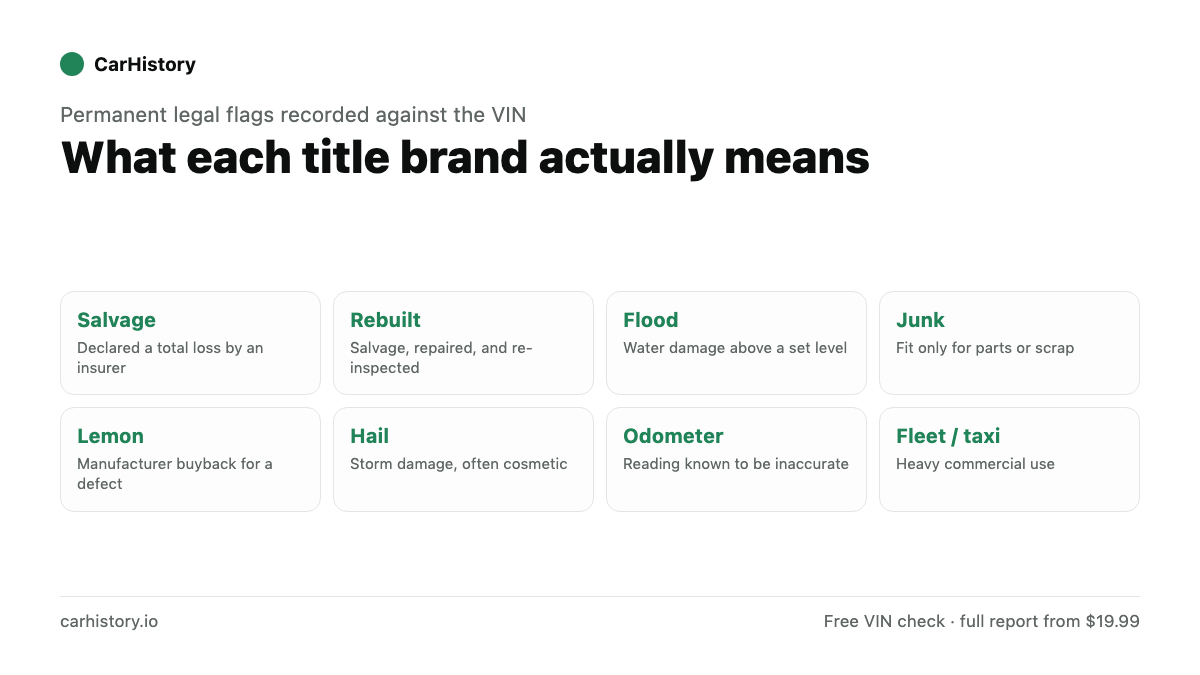
A title brand is a permanent legal label a state adds to a vehicle’s title when the car has a serious problem in its past, such as major damage, a total loss, flooding, or a manufacturer buyback. Brands like salvage, rebuilt, flood, junk, and lemon law buyback warn future buyers and stay attached to the VIN for the life of the car.
Why title brands matter when buying a used car
Title brands exist to protect buyers. When something major happens to a vehicle, the state records it on the title so the next owner is not buying a problem blindly. A brand affects far more than paperwork:
- Value. Branded titles almost always sell for less than clean-title equivalents, and that discount follows the car to every future sale.
- Safety. Many brands signal damage that may have weakened the frame, airbags, or electronics.
- Financing and insurance. Some lenders will not finance a branded vehicle, and some insurers limit coverage.
- Resale. Cautious buyers avoid branded cars, so they are harder to sell later.
The brand alone never tells you the quality of any repair. It tells you what was reported, which is exactly why you want to read the full record before you commit.
The most common title brands
Here is a plain-English glossary of the brands you are most likely to encounter. A single VIN can carry more than one.
Salvage title
A salvage title means an insurance company declared the vehicle a total loss, usually because the cost to repair it crossed a state threshold after a crash, fire, theft, or disaster. A salvage car generally cannot be legally registered or driven until it is repaired and re-inspected. The brand is permanent. For a deeper look, see What Is a Salvage Title?.
Rebuilt or reconstructed title
A rebuilt title (sometimes called reconstructed or restored) is a salvage vehicle that was repaired and passed a state inspection, making it legal to drive again. It is no longer “salvage,” but the history remains on the record. Two rebuilt cars with the same brand can vary wildly in repair quality, so documentation and an independent inspection matter most here.
Flood or water damage title
A flood brand means the vehicle sat in enough water to cause damage. Flooding is especially concerning because water corrodes wiring, sensors, and safety electronics over time, and problems can surface months or years later. Flood cars are sometimes cleaned up and resold across state lines. Learn how to spot the signs in our guide on flood damage.
Junk title
A junk title (sometimes “non-repairable” or “certificate of destruction”) means the vehicle was declared unfit to ever return to the road. It is meant only for parts or scrap. A car with a junk brand should never be sold as a roadworthy vehicle, so seeing this label on something for sale is a serious red flag.
Lemon law buyback title
A lemon law buyback (also called manufacturer buyback or repurchase) means the manufacturer was legally required to buy the car back because of a defect it could not fix after repeated attempts. The car is usually repaired and resold with a permanent brand. It does not always involve a crash, but you should learn exactly which defect triggered it. See Lemon Law Buyback Titles Explained.
Odometer brands
Some titles carry an odometer-related brand such as “not actual mileage,” “exceeds mechanical limits,” or “odometer discrepancy.” These flags warn that the recorded mileage may be wrong, sometimes because of tampering. Mileage fraud is common enough that it deserves its own checks, covered in How to Spot an Odometer Rollback.
Other brands you may see
A handful of less common brands turn up depending on the car and the state:
- Hail or fire damage describes the specific cause of a loss.
- Theft recovery marks a car that was stolen and later recovered.
- Gray market flags a vehicle originally built for sale in another country.
- Taxi, police, or fleet use indicates heavy commercial use, often with high real-world wear.
- Manufacturer warranty return is a sibling of the lemon law buyback.
Brand names and wording vary by state, so the same event can appear under different labels depending on where the car was titled.
Why brands can hide between states
Each state runs its own titling system, and a car can be re-titled when it moves. Occasionally a vehicle is moved specifically to wash a brand off its paperwork, a practice known as title washing. That is why a brand applied in one state can disappear from a careless check.
The defense is simple: pull a history report that draws on national title and DMV data and watch for state-to-state transfers that do not add up. Because CarHistory combines records from multiple national databases into one de-duplicated report, a brand recorded in only one source still shows up. If you want to understand how those reports are built, read How Vehicle History Reports Work.
How to check a VIN for title brands
You never have to take a seller’s word for it. The VIN is your key to the recorded past.
- Find the 17-character VIN. It sits on the driver-side dashboard, the door-jamb sticker, and the title or registration. If you are not sure you have the right number, our How to Read a VIN guide decodes every character.
- Run a free check first. A free VIN check confirms the year, make, and model and shows how many history records exist, so you know whether history data is available before paying. See exactly what is free in our Free VIN Check guide.
- Unlock the full report. A paid report reveals title brands, accident and damage history, odometer readings, ownership history, and open recalls in one place. Check the pricing so you know the cost up front, and preview the layout with a sample report.
- Read the brand fields carefully. Note the exact label, the state, and the date, then ask the seller for documentation that explains the event and any repair.
What to do when you find a brand
A brand is not automatically a reason to walk away, but it changes how you approach the deal:
- Ask for documentation. Request repair invoices, inspection certificates, and before-and-after photos.
- Get an independent inspection. Have a trusted mechanic examine the frame, structure, and safety systems.
- Negotiate on price. A branded title should be reflected in what you pay.
- Follow a full routine. Work through the used car buying checklist so nothing slips through.
When no data is found
Not every VIN returns records, especially newer cars or those with limited reporting. An empty result does not guarantee a clean past; it may simply mean nothing has been reported yet. With CarHistory, if a paid report turns up no data, your credit is refunded automatically, so you are never charged for an empty report. Learn more in VIN Not Found? What It Means.
The bottom line
Title brands are permanent flags that tell you something serious once happened to a car. None of them is guaranteed to be a dealbreaker, but every one demands extra diligence: documented repairs, an independent inspection, and a fair price. The fastest way to know what you are dealing with is to check the VIN before you fall for the car.
Run a free VIN check now to see what records exist for any vehicle you are considering.
Sources
- NMVTIS (U.S. Department of Justice) — Brands are issued by individual states; NMVTIS is the federal system that makes them visible across state lines.
- NICB VINCheck — Free lookup for insurance-reported salvage, flood and theft records.
Check your vehicle's history