← All guides
Lemon Law Buyback Titles Explained
A lemon law buyback means a manufacturer repurchased a defective car. Learn what the title brand means and how a history report flags it before you buy.
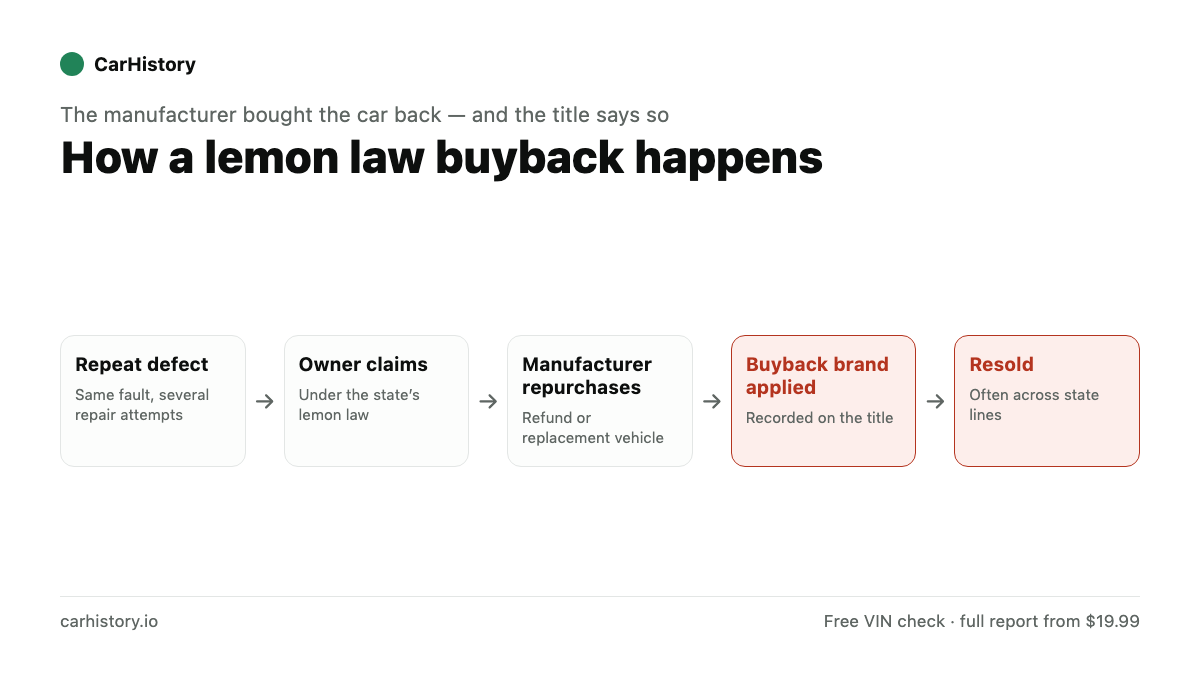
A lemon law buyback is a vehicle that the manufacturer was legally required to repurchase because it had a serious defect that could not be fixed after repeated repair attempts. Once bought back, the car is often resold, and most states require its title to carry a permanent “lemon law buyback” or “manufacturer buyback” brand so future buyers know its history.
What “lemon law buyback” actually means
State lemon laws protect new-car buyers when a vehicle has a defect that the dealer or manufacturer cannot repair within a reasonable number of attempts or after the car has been out of service for an extended period. When that happens, the manufacturer must either replace the vehicle or buy it back from the original owner.
The repurchased car does not get crushed. It is usually repaired and resold, sometimes in a different state. To keep that history transparent, the car receives a branded title. You may see it labeled in a few ways:
- Lemon law buyback
- Manufacturer buyback
- Manufacturer repurchase
- Warranty return
The exact wording depends on the state, but the meaning is the same: a manufacturer once decided this specific vehicle was not worth keeping.
Is a buyback car safe to buy?
Not automatically bad, but you need the full story. A buyback can be a reasonable purchase if:
- The original defect was clearly documented and has since been repaired
- The brand reflects a problem unrelated to safety, such as a persistent electronics or trim issue
- The price is discounted to reflect the branded title
It becomes risky when the underlying defect was safety-related, recurring, or never fully resolved. Because the title brand alone does not tell you what was wrong, your job is to find out exactly which defect triggered the buyback before you commit.
How a buyback affects value and resale
A buyback brand is permanent and follows the VIN for the life of the car. That has real consequences:
- Lower resale value. Branded titles typically sell for less than clean-title equivalents, and that discount sticks with every future sale.
- Financing and insurance hurdles. Some lenders will not finance a branded vehicle, and insurance can be harder to place.
- Harder to sell later. Cautious buyers walk away from branded titles, so plan on a smaller pool of future buyers.
If a deal looks too good for the year and mileage, a hidden buyback brand is one common reason. Check the pricing on any report you buy so you know the cost before unlocking the details.
How a vehicle history report flags a buyback
A history report is the fastest way to surface a buyback brand because the information lives in title and DMV records, not on the car itself. A good report will show:
- The current title brand, including “lemon law buyback” or “manufacturer repurchase”
- The state and date the brand was applied
- Any state-to-state title transfers, which can reveal a car re-titled to shed or obscure a brand
- Related records such as repair history, recalls, or open safety campaigns
CarHistory combines records from multiple national databases into one de-duplicated report, so a buyback recorded in only one of those sources still shows up. That matters because a brand applied in one state can be missed if you only check a single data source. To understand how those reports are built, see our guide on How Vehicle History Reports Work.
If a brand is reported but no underlying data is found for a VIN, CarHistory refunds the credit automatically, so you are never charged for an empty report.
Buyback vs. other title brands
A lemon law buyback is easy to confuse with other branded titles, but they describe different events:
- Salvage means an insurer declared the car a total loss, usually after a crash, theft, or disaster. Read more in What Is a Salvage Title?.
- Rebuilt means a salvage vehicle was repaired and re-inspected for road use.
- Flood means water damage, which can cause long-term electrical problems.
- Lemon law buyback means a manufacturer defect triggered a repurchase, not necessarily any accident or damage.
A single VIN can carry more than one brand. For the full list of what each label means, see Title Brands Explained.
How to check a VIN for a buyback before you buy
You can confirm a buyback without leaving the listing:
- Find the 17-character VIN. It is on the driver-side dashboard, the door jamb sticker, and the title or registration. If you are unsure you have the right number, our How to Read a VIN guide breaks down each character.
- Run a free check. A free VIN check confirms the year, make, and model and shows how many history records exist for that car.
- Unlock the full report. A paid report reveals title brands, accident and damage history, odometer readings, ownership history, and open recalls in one place. Preview the layout with our sample report.
- Read the brand carefully. Look for the exact label, the state, and the date, then ask the seller for documentation of the original defect and its repair.
It is also smart to cross-check odometer readings, since branded and resold cars are more likely to have inconsistent records. Our odometer rollback guide shows what to watch for. For a full pre-purchase routine, follow the used car buying checklist.
The bottom line
A lemon law buyback is not always a dealbreaker, but it is never something to discover after you sign. The brand is permanent, it lowers value, and the only way to know what defect caused it is to read the records. A quick VIN check tells you whether a car has a buyback brand before you spend a dollar on it.
Run a free VIN check now to see what records exist for any car you are considering.
Sources
- NMVTIS (U.S. Department of Justice) — Manufacturer buyback and lemon brands are applied by states; NMVTIS carries them between states.
- Buying a Used Car From a Dealer — Federal Trade Commission — Consumer guidance on used-car purchases and the disclosures a dealer must make.
Check your vehicle's history